Multi-hop laundering
Peeling chains, mixers and bridges dilute a straightforward trail.
SIH 26182 · Ministry of Home Affairs / I4C
SAHYOG is an explainable multi-chain investigation system that follows tainted cryptocurrency through wallets, mixers and bridges, ranks the likely VASP off-ramp, and prepares a reviewable legal case package.
01 — Why this matters
A criminal can split, bridge, mix and relay funds through dozens of wallets before depositing at an exchange. Investigators need more than a transaction list: they need a defensible trail to an off-ramp and a lawful path to request KYC records or freeze assets.
Peeling chains, mixers and bridges dilute a straightforward trail.
Off-ramp wallets must be linked to a VASP before KYC can be sought.
A result must be accompanied by an explainable and sealed evidence record.
Tracing cannot stop because one explorer has a rate limit or outage.
02 — Global scale & India context
These figures use different scopes and should not be added together. Together, they show why tracing, attribution and rapid freezing workflows matter.
A lower-bound estimate; historical address discovery could move the total closer to $51B.
Chainalysis, 2025 ↗Known on-chain scam addresses; the estimate may exceed $12B as more addresses are identified.
Chainalysis, 2025 ↗149,686 complaints referencing cryptocurrency, with reported losses up 66% year over year.
FBI IC3, 2024 ↗INTERPOL reported 5,811 arrests, 142,000+ identified victims and $293M in intercepted assets.
INTERPOL, 2026 ↗03 — Objectives & scope
SAHYOG is designed to accelerate a trained investigator, not replace the legal and factual decisions they are responsible for.
Trace a suspect wallet across EVM, Bitcoin and TRON data sources.
Reduce a large transaction neighbourhood into explainable candidate paths.
Combine known VASP clusters with sanctions and threat intelligence.
Rank likely off-ramps while showing confidence and competing candidates.
Escalate low-confidence conclusions instead of silently over-claiming.
Preserve graph evidence, risk signals and audit history for review.
04 — The current implemented flow
This reflects the current backend route and UI: collect deeply, reduce the graph, keep evidence streams separate, then present the shortest defensible route.
trace_multi_hop() follows transactions up to 15 hops and 2,000 addresses, using chain-specific sources and offline fallback data.Observed transactions, deterministic matches, learned inference and officer action remain distinguishable throughout the case.
05 — System architecture
The platform separates collection, graph compute, model inference, decision-making and storage so each piece can be inspected, scaled or replaced independently.
06 — A case, explained visually
This is the investigator’s mental model: trace outward, reduce the graph to meaningful paths, attach independent evidence, then package the result for action.
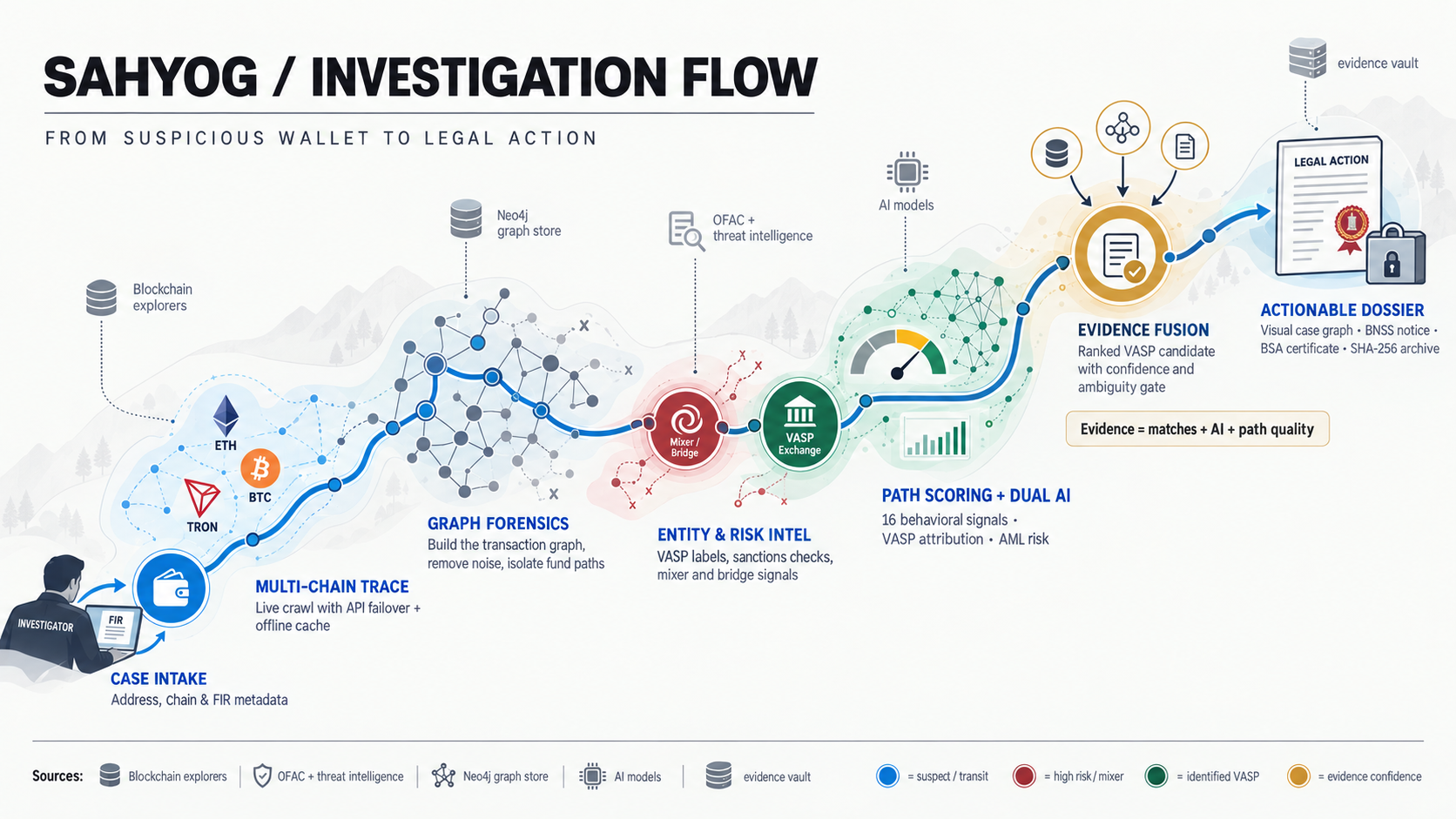
07 — What happens inside the investigation
The system checks the address against chain-specific formats, records case metadata, and starts an immutable audit trail.
CASE + ADDRESS VALIDATIONBFS expands the fund trail up to 15 hops, caps fan-out to prevent exchange-wallet explosions, and falls back across explorer APIs or local cache.
EVM · BTC · TRONDust, leaves and peripheral transfers are pruned. Directed candidate paths from suspect wallet to potential VASP exits are retained.
NEO4J / NETWORKXWallets are checked against verified exchange clusters, OFAC sanctions data, drainer and malicious-contract intelligence, and FIU-linked VASPs.
VASP + SANCTIONS INTELLIGENCEPath scoring rewards coherent movement and records uncertainty introduced by peeling chains, mixers, tumbler hops and cross-chain bridges.
FORENSIC PATH QUALITYEvidence is fused into a ranked attribution. Low score or low top-two margin triggers analyst review instead of an automatic legal action.
HUMAN-IN-THE-LOOP GATE08 — Model and decision layer
Temporal heterogeneous graph learning maps wallets, VASPs and mixers into a typed graph. It produces VASP attribution probabilities across eight known exchange classes.
A graph convolutional model trained against the Elliptic benchmark estimates illicit-activity risk from topology and transaction-level patterns.
Exact matching, learned attribution and path quality remain separate until the last stage. Entropy and top-two margin decide whether the system can recommend action.
09 — Related news / multi-hop case
BYBIT THEFT · FEBRUARY 2025The FBI attributed the Bybit theft to North Korea’s TraderTraitor activity. Its public alert says the actors converted some stolen assets to Bitcoin and other virtual assets, dispersed them across thousands of addresses on multiple blockchains, and were expected to continue laundering toward fiat conversion.
FBI public service announcement, 26 February 2025 ↗
Multi-chain crawlers reconstruct the transaction neighbourhood; graph pruning isolates coherent fund corridors; threat intelligence flags actor-linked addresses; route scoring records bridge and mixer uncertainty; VASP attribution prioritises the cash-out point where lawful intervention is possible.
10 — Previous scams & laundering patterns
These cases show why a useful system must track paths and services—not merely flag the starting wallet.
The US Department of Justice described mixers, non-compliant exchanges, darknet markets and domestic and overseas bank accounts in the laundering plan.
DOJ case overview ↗Authorities said the service commingled Bitcoin to make criminal proceeds harder to trace, supporting ransomware, fraud, darknet and hacking activity.
DOJ takedown ↗The DOJ alleged that the feature introduced unnecessary transactions to make source recognition harder for exchanges and investigators.
DOJ announcement ↗The allegations, legal status and outcomes differ by case; the linked official material provides the precise context.
11 — What the investigator receives
SAHYOG turns a complex trace into materials investigators can review, communicate and preserve.
Trace wallets, risky nodes, VASP destinations and paths through a time-aware graph workbench.
See deterministic matches, model probabilities, path quality, sanctions flags and the final confidence tier.
Pre-populated BNSS Section 94 requisition for the VASP nodal officer and associated account information.
BSA Section 63 certificate, case dossier and SHA-256 seal establish an auditable electronic chain of custody.
12 — Implementation stack
13 — Research sources
External figures and cases link to public research or official law-enforcement material. Architecture and flow descriptions come from this repository’s implementation and project documentation.